A few days ago a partner at a VC firm messaged us: "I probably need to build a skill in Claude for general bizdev assistance for our portfolio companies. I usually receive a spreadsheet with companies, and sometimes names of specific people. Any guidance, or pre-built skills to start with?" If you work at a fund, you know that spreadsheet. Here's the workflow that turns it into actual introductions - and the pre-built skill that runs it.
The spreadsheet black hole
Every VC says "we open doors for our portfolio." The test is what happens when a portfolio CEO actually sends the list: 100 target accounts, plus a line like "our buyer is VP and above in Marketing."
What usually happens next: the list lands with whoever owns portfolio support - a platform lead, head of network, sometimes a chief of staff - and their job becomes detective work. Forward the list to the partners with "anyone know people at these?", chase the two replies that come back, scroll partners' LinkedIn connections one company at a time, keep a spreadsheet of guesses. Partners skim it on their phones and recognize four logos. Not from bad faith - from arithmetic. No individual's memory covers a firm's collective network, and even a dedicated person doesn't have a week to manually check 100 companies against 20 people's networks.
The workflow that actually works
The funds we see do this well have stopped treating portfolio intros as a memory exercise. They run the same three steps every time:
- Take the list as-is. Company names and domains in a CSV - exactly what the portfolio company already sends. No reformatting homework for the founder.
- Take the ICP as a sentence. "VP and above in Marketing." "Heads of Engineering and CTOs." "Anyone senior in procurement." Titles, function, seniority - that's the whole spec.
- Search the firm's entire network against both. Not who the partners remember - who the firm actually knows: every partner, every associate, and the extended network of LPs, advisors and other portfolio founders. Real relationships, scored from two-way interaction, ranked by strength.
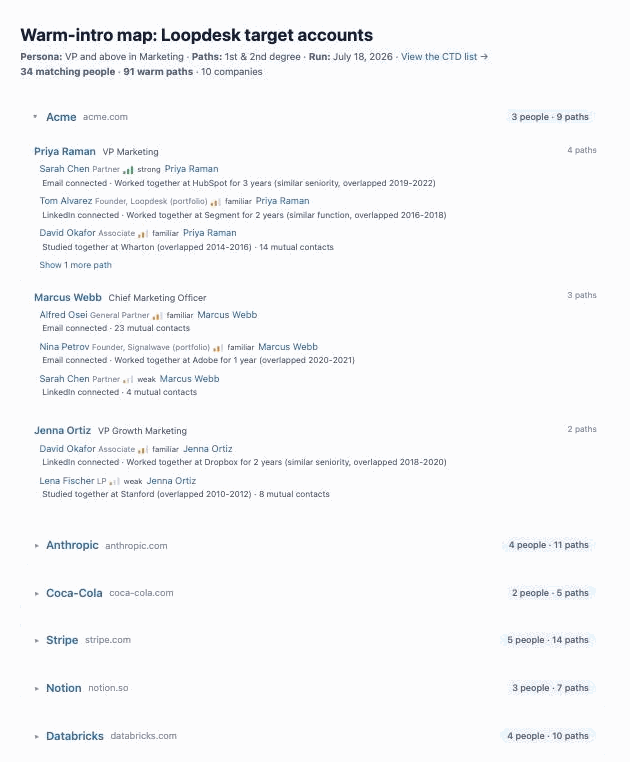
The output that comes back to the portfolio CEO isn't "we'll ask around." It's: here are the 40 accounts on your list where we have warm paths, here's every person there who matches your buyer profile, and here's who at our firm - or in our extended network - has the strongest real relationship with each of them.
We packaged it as a Claude skill
We kept getting asked for this workflow, so we packaged it as a Claude skill anyone can install: /ctd-portfolio-introductions. It runs on the CTD MCP, which means Claude is querying your firm's live relationship graph, not a static export. What it does, step by step:
- Validates the list - checks every domain in the uploaded CSV, flags dead or mistyped ones before they waste anyone's time.
- Creates a company list in CTD - the target accounts become a living list in your workspace, and the skill hands you the link immediately, so the platform team can track paths and job changes on it long after the chat ends.
- Finds every reachable person matching the ICP - filtered by the titles, function and seniority the portfolio company defined.
- Maps the best paths to each person - up to 20 ranked routes, with the strongest connector first and a plain-language reason each path is recommended.
- Generates a shareable report - a single page with every reachable person, their match to the ICP, and the ranked warm paths through your firm. Forward it to the portfolio CEO as-is.
Install takes two minutes - the full walkthrough, requirements and download are in the portfolio introductions skill guide.
Why this works better than asking around
- It searches relationships, not memories. The path to a CMO is just as likely to run through an associate's former coworker as through a partner - no one would ever surface that by asking around.
- Strength is scored, not guessed. Paths are ranked from real two-way interaction history, so the intro request goes to someone who will actually be recognized - not a LinkedIn connection from 2019.
- The network compounds. Portfolio founders, LPs and advisors can join as external members, which adds their relationships to the searchable graph. In practice this is the biggest lever: across a 30-company portfolio, most target accounts are reachable through someone.
- It's repeatable, and honest about gaps. When the target list changes next quarter, you re-run one prompt. And when the network genuinely doesn't reach an account, the report says so - "no coverage" is a valid result, and knowing it early saves everyone time.
Common questions
What should the portfolio company send?
A CSV with company names and domains, plus one sentence describing the buyer: titles, function, seniority. That's the entire input - the skill handles validation and everything after.
What if the firm has no direct relationship at an account?
The firm's reachable network is much bigger than its employees. LPs, advisors and other portfolio founders join as external members, and their relationships become searchable paths too. Across a real portfolio, true dead ends are rare.
Does the portfolio company see the firm's whole network?
No. The firm runs the search and shares the results. What's visible to whom is controlled with CTD's granular privacy settings - relationship signals, never message content, and every member decides what they share.
Can this handle named people, not just companies?
Yes - when the spreadsheet includes specific names ("we want to reach this VP at this company"), the same search maps paths to those exact people.
Your portfolio companies aren't asking for your money twice - they're asking for your network. Until now, "our network" has mostly meant whatever the partners happen to remember. Once the whole graph is searchable, the spreadsheet stops being an awkward favor and becomes a process: list in, warm paths out, every quarter. That's the entire idea.