If you run a venture fund, you've almost certainly evaluated Affinity - and there's a good chance you're paying for it. It's the category leader in CRM for private capital, and it earned that position. So when firms ask us "is CTD an Affinity alternative?", the honest answer is: sometimes - but it's usually the wrong question. The two products do different jobs. This post lays out exactly what each one does that the other can't, and how the many firms that use both make them work together.
What Affinity does well
Credit where it's due. Affinity pioneered the idea that a CRM should build itself from your team's inboxes and calendars instead of relying on manual data entry. It gives funds a shared pipeline with stages, lists and custom fields; automatic activity capture on every deal; company enrichment through data partners; portfolio tracking; and reporting your ops team can build an IC process around. Hundreds of institutional funds run their entire deal flow on it, and reviewers consistently rate it among the best CRMs in private capital.
It also comes with an institutional price tag: Affinity doesn't publish pricing, and it's sold on quote-based annual contracts. For a full-service system of record, many funds decide that's worth it.
What CTD does that Affinity can't
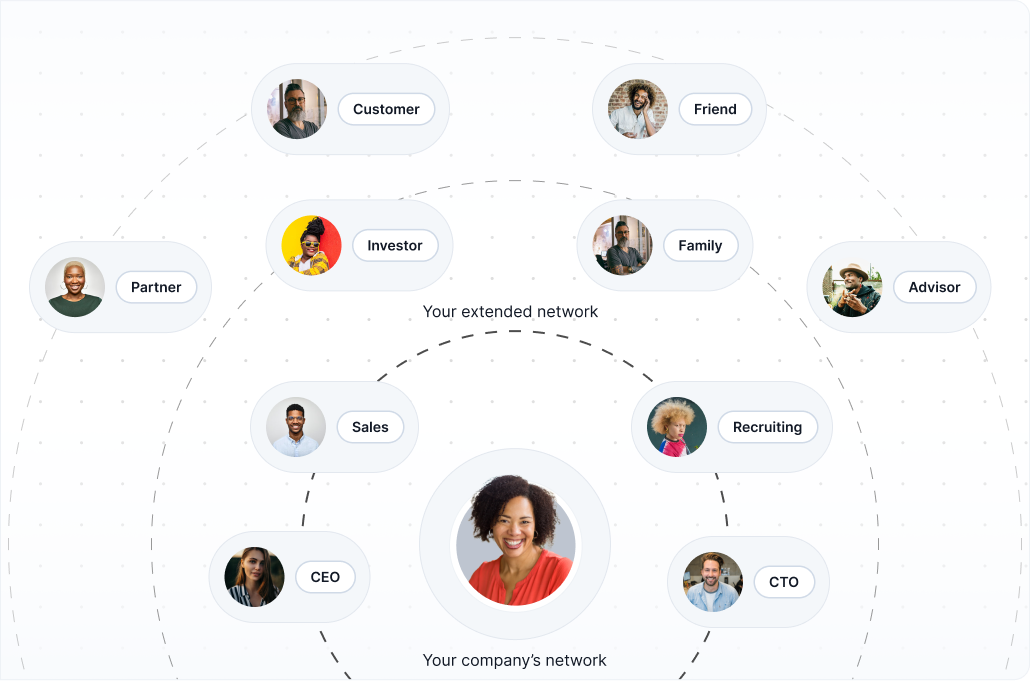
Affinity's relationship intelligence has one structural boundary: it's built from communications that flow through your firm's mailboxes and calendars. That's a rich source, but it's a fraction of the relationships your fund can actually activate. CTD is built to capture the rest.
A graph that extends beyond your firm's inbox
CTD maps email and LinkedIn - surfacing thousands of relationships per person that never touched a work mailbox. And it's not limited to one inbox per person: each member can sync an unlimited number of personal email accounts. A partner's decade of relationships from a previous firm isn't in your firm's email history - but it surfaces anyway, through their LinkedIn connections, their personal inboxes and the career overlap CTD infers.
Inferred relationships
CTD detects relationships from overlapping employment, shared board seats and career signals - even when there's no email thread or LinkedIn connection to observe. Interaction-based systems can't see a relationship that never generated an interaction in their data.
Your portfolio's network, not just your own
Portfolio founders and execs can join CTD as free external members, making their first-degree networks searchable by the fund. Sixty portfolio companies can mean 30M+ first-degree connections. No CRM can see this, because these people don't use your CRM.
From path to intro: ghost emails
Finding the path is half the job. CTD's ghost emails let your team draft the intro on behalf of the connector, who reviews and sends in one click - so intros actually happen instead of dying in a Slack thread.
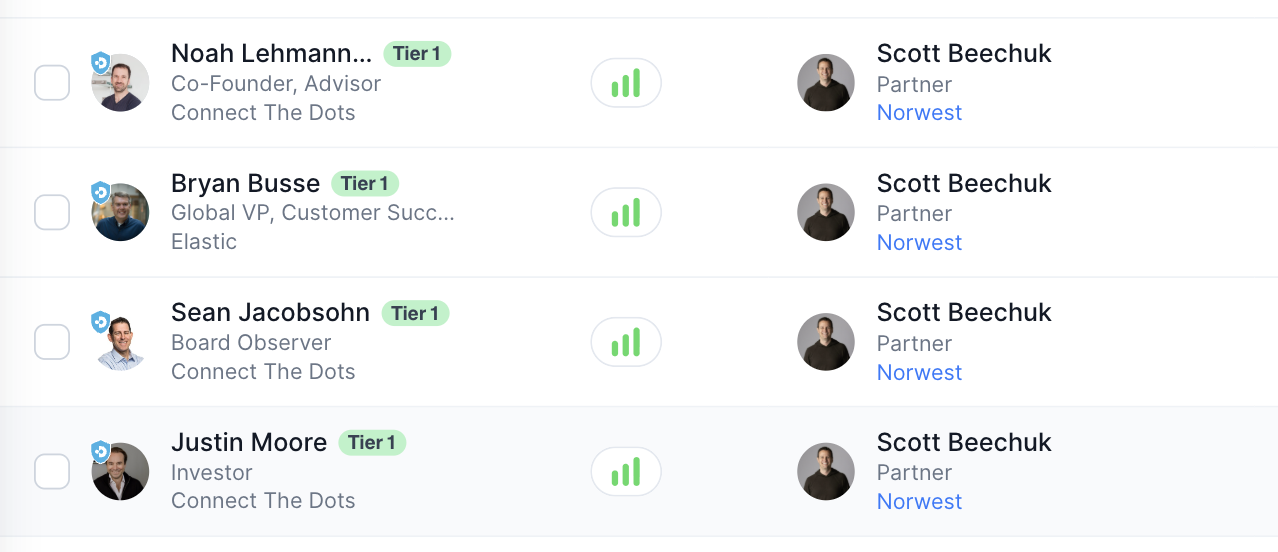
For funds, the right fit is CTD's Business edition - built for firm-wide rollout with unlimited external members, SSO and a dedicated CSM - and it typically comes in well below a comparable Affinity contract. Book a demo and we'll scope it for your firm.
And the graph keeps getting more complete. Email and LinkedIn are where it starts, not where it ends: our roadmap brings in the rest of the places your relationships actually live - phone contacts, WhatsApp, Slack, Instagram and beyond. The goal is simple: one place where every relationship you have is visible, scored and actionable - whatever channel it lives on. As always, CTD extracts relationship signal, never message content.
What Affinity does that CTD doesn't
Just as important is what CTD doesn't do - because this is usually what decides whether Affinity stays.
- Full pipeline management. Affinity is a purpose-built deal CRM: stages, kanban boards, lists, custom fields, deal team assignments. CTD covers the lightweight end of this - stages for paths and companies, lists and kanban boards - but it doesn't have custom fields or deal team workflows, and it isn't trying to be your CRM.
- System of record. Notes, files, meeting history and a permanent record of every touchpoint on a deal live in Affinity. CTD deliberately doesn't store your communications - it extracts relationship signal, not content.
- Deep firmographic enrichment. Affinity enriches company records with funding, headcount and industry data through its data partnerships. CTD enriches companies with the basics - size, industry, location, description - but not funding history or other investment-grade data.
- Portfolio and fund reporting. Dashboards, deal flow analytics and the reporting layer your IC and LPs expect - that's CRM territory.
Side by side
| Affinity | CTD | |
|---|---|---|
| Category | CRM / system of record for private capital | Relationship intelligence layer |
| Relationship data source | Your firm's email & calendar | Email + LinkedIn + inferred career & board overlaps |
| Network scope | People your firm has interacted with | Your firm + portfolio founders, advisors & LPs as free external members |
| Deal pipeline & reporting | Full CRM - core strength | Lightweight: stages, lists & kanban boards |
| Company enrichment | Deep - funding & more, via data partners | Basics: size, industry, location, description |
| Intro execution | Manual | Ghost emails - draft for your connector, one-click send |
| AI agent access | API | Full API + MCP (works inside Claude & any agent) |
The questions every firm asks us
Can we replace Affinity with CTD?
It depends on what Affinity is doing for you. If it's your system of record - pipeline, portfolio tracking, reporting - then no, and we'll tell you that on the first call. If you bought it primarily to answer "who knows this founder?", CTD answers that question with a much broader graph at a fraction of the cost, and some smaller funds do run CTD alongside a lightweight CRM (or none at all). But for most established funds, the realistic framing is augment, not replace.
Can we integrate CTD data into Affinity?
Yes. CTD exposes everything - warm paths, scored relationships, job changes - via a REST API, and Affinity's API supports writing to list fields. Affinity scores relationships too, but only from what flows through your firm's email and calendar. CTD's score draws on the complete graph - LinkedIn, personal inboxes, portfolio networks and inferred career overlap - so teams that sync the two make CTD's score the one that lives on their Affinity records. One score, built from everything. There's no one-click native connector today; we work directly with customers to stand up integrations like this, so if you want it, talk to us.
Can we integrate Affinity data into CTD?
Yes, and this direction is even easier. Export your active target companies from Affinity and push them into CTD through the target-accounts import API (each row just needs a website or LinkedIn URL) or upload them as a list. CTD then surfaces every warm path your firm and portfolio have into those exact accounts - scored, ranked and ready to act on.
What are the best practices for running both?
- Keep Affinity as your system of record. Pipeline, notes, portfolio metrics and reporting stay where your team already manages them.
- Sync your target list into CTD. Push active pipeline and sourcing targets from Affinity into CTD on a regular cadence, via API or list upload, so warm paths are always mapped to what you're actually working.
- Check CTD before any outreach. Make "is there a warm path?" the first step of every sourcing motion. Cold email is the fallback, not the default.
- Invite your portfolio as external members. This is the single highest-leverage step - it's free for them and can multiply the fund's searchable network many times over.
- Execute intros with ghost emails. Draft the intro for your connector so the ask takes them twenty seconds, not twenty minutes.
- Put CTD where your team already works. Via MCP, your partners can ask "who has the strongest path into this company?" directly in Claude - no new tab, no new habit.
The bottom line
Affinity built one of the best CRMs in private capital, and if your firm runs its pipeline on it, keep it. But your CRM can only see relationships that pass through your firm's own mailboxes - and the warm path that wins your next deal is at least as likely to run through a portfolio founder's former CTO or a partner's pre-fund network. That's the layer CTD adds: the complete, scored relationship graph of your firm and everyone around it, wired to turn paths into introductions. The funds getting the most from their network aren't choosing between the two. They're letting each tool answer the question it was built for.